
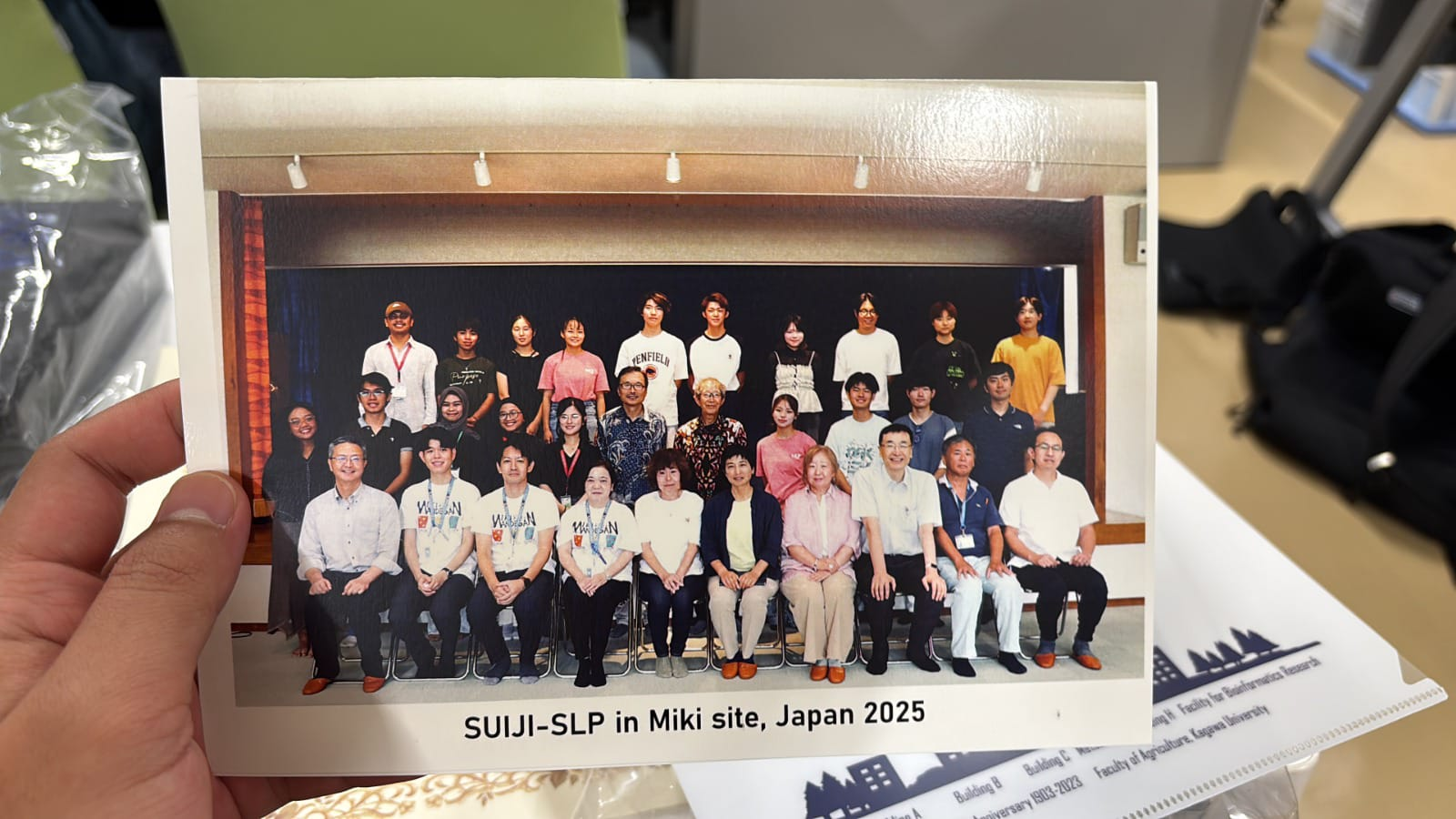
The Faculty of Agriculture at Universitas Gadjah Mada (UGM) continues to support students in gaining meaningful learning experiences beyond the classroom through direct engagement with communities. One example is student participation in the SUIJI Service Learning Program (SUIJI-SLP), an international exchange program that combines academic learning, field observation, problem-solving, and cross-cultural exchange through a service-learning approach.

Muhammad Syahru Ramadhan, a student of the Faculty of Agriculture UGM, had the opportunity to participate in the SUIJI-SLP program, which brought together students from various universities in Indonesia and Japan. The program involved participants from UGM, IPB University, Hasanuddin University, and Kagawa University in Japan. Through this exchange experience, Syahru gained valuable insights from academic activities, community observations, and collaborative problem-solving initiatives. According to him, every activity within the program was meaningful and impactful because SUIJI-SLP emphasizes learning through direct community engagement. “During the exchange program, I gained many valuable experiences, ranging from learning activities to problem-solving processes. In my opinion, every agenda in SUIJI-SLP felt meaningful and beneficial because the program focuses on Service Learning,” said Syahru.
Syahru explained that the program activities were divided into several stages: observation, brainstorming, and problem-solving or solution development. During the observation phase, participants studied local community conditions to identify challenges, assess community needs, and design appropriate solutions. In addition to community-based activities, students also participated in academic learning sessions on campus. “The exchange activities were structured into observation, brainstorming, and solution-development stages. During the observation phase, we learned about local conditions and community issues to formulate potential solutions, while also participating in academic activities at the university,” he explained.
Throughout the observation period, participants were encouraged to engage closely with local communities through various activities. Syahru and his fellow participants had opportunities to explore local neighborhoods, interact with children, visit companies, participate in festivals, and engage in community events. One of the most memorable experiences for him was participating in the Tanaka Summer Festival, a community-organized cultural event. During the festival, Syahru and his colleagues had the opportunity to introduce Indonesian culture through traditional performances and Indonesian cuisine. He described the event as one of the highlights of the program, particularly because of the enthusiastic response from local residents. “One of the most unforgettable experiences was participating in the Tanaka Summer Festival. I was delighted to perform the Indonesian dance Gemu Fa Mi Re and witness local residents enthusiastically joining us in the dance,” Syahru recalled.
In addition to performing Gemu Fa Mi Re, the participants also sang the Indonesian folk song Yamko Rambe Yamko and the Japanese song Kokoronotomo. They also prepared Indonesian dishes that were shared and enjoyed together with members of the local community. According to Syahru, the warm reception from local residents made him feel welcomed and appreciated throughout the program. These direct interactions provided meaningful cultural exchange experiences and broadened his understanding of social and cultural life in another country.
“The enthusiasm of the local community and the opportunity to interact directly with residents made me feel truly welcomed and grateful to be part of the SUIJI-SLP program,” he said. The program also enabled Syahru to expand his network by connecting with students from diverse academic and cultural backgrounds. He noted that the diversity of participants created valuable opportunities to exchange perspectives on academic, social, and cultural issues.
Beyond cultural exchange, SUIJI-SLP allowed students to apply knowledge gained from their studies at both UGM and Kagawa University in real-world settings. Concepts and theories learned in the classroom were tested through field observations, discussions, and the development of community-based solutions. This hands-on experience strengthened participants’ understanding of how academic knowledge can be utilized to address real societal challenges. “Through this program, the knowledge we gained from classes at UGM and Kagawa University could be directly applied in the field. Other positive outcomes included increased environmental and social awareness, enhanced leadership skills, and unforgettable cultural exchange experiences,” Syahru explained.
The participation of UGM Faculty of Agriculture students in the SUIJI-SLP program reflects the university’s commitment to experiential learning, international collaboration, and community engagement. The program aligns closely with the principles of the Tri Dharma of Higher Education, particularly in integrating education, community service, and meaningful societal contributions.
This activity contributes to the achievement of SDG 4 (Quality Education), SDG 11 (Sustainable Cities and Communities), SDG 16 (Peace, Justice and Strong Institutions), and SDG 17 (Partnerships for the Goals).
Author: Faeydza Dumyati Ali
Editor: Agung Dian Kharisma